
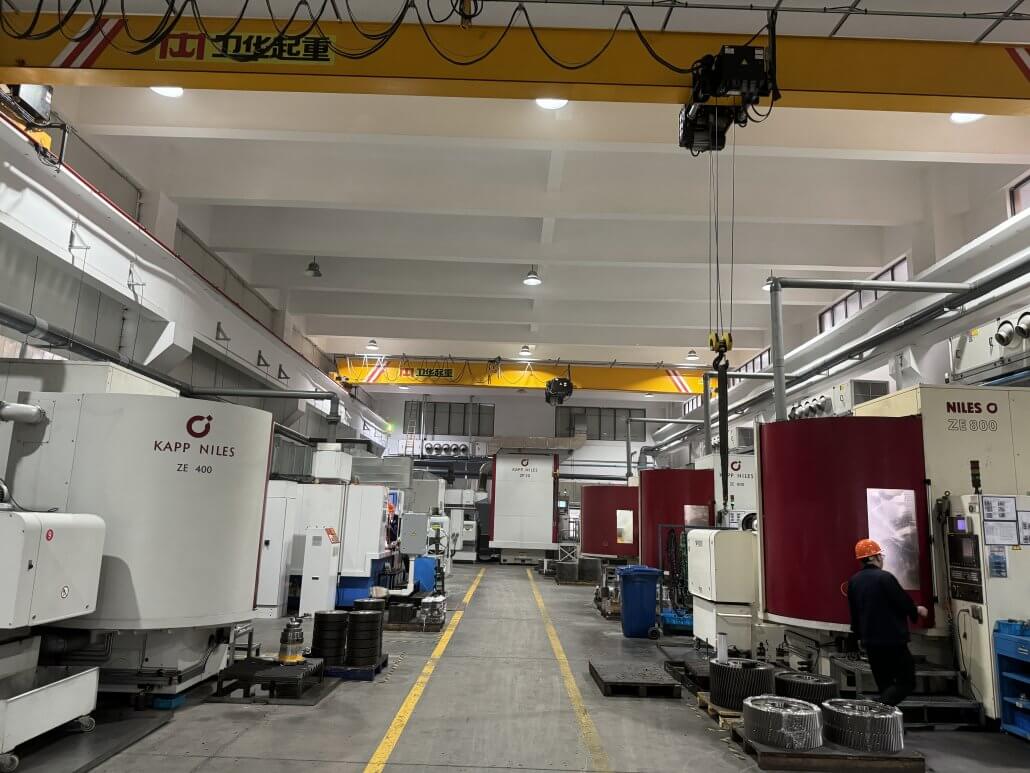
How to Select Gearbox Ratio and Torque for Monofilament Extrusion Lines
Gearbox selection for a monofilament extrusion line starts with the process requirement, not with the gearbox catalogue. The correct unit must deliver the screw-speed range and torque required by the polymer and product while remaining reliable under continuous production conditions.
The most important inputs are motor power, motor speed, target screw speed, expected load, operating hours and the mechanical loads at the screw. The following method provides a practical framework for preliminary selection.
1. Start with the required screw-speed range
The transmission ratio is determined primarily by the relationship between motor speed and screw speed:
Gearbox ratio ≈ motor speed ÷ screw speed
If a motor operates at 1,480 rpm and the required nominal screw speed is 60 rpm, the basic ratio is about 24.7:1. The final ratio should then be checked against the full operating range of the line and the available frequency range of the motor drive.
For variable-speed extrusion lines, engineers should verify both ends of the operating window. Very low motor frequency can reduce motor cooling and usable continuous torque, so mechanical ratio selection should not rely on the variable-frequency drive alone.
2. Convert power and speed into output torque
A useful preliminary relationship is:
Torque (N·m) ≈ 9550 × Power (kW) ÷ Speed (rpm)
For example, a 55 kW drive operating at 60 rpm corresponds to approximately 8,750 N·m before allowances for efficiency, process variation and service factor. This is why output torque often becomes the controlling gearbox parameter in extrusion applications.
The calculated nominal torque is only the starting point. Startup behavior, polymer viscosity, screw loading, temporary process disturbances and the number of operating hours per day must also be considered.
3. Apply an appropriate service factor
Continuous extrusion is not the same as a light intermittent duty. A suitable service factor provides margin for real operating conditions, including load variation and extended running time.
The required factor depends on the machine design and operating profile. Rather than applying an arbitrary number, the manufacturer should review actual motor power, screw duty, starts per hour, operating hours and any known shock loading.
4. Check thermal capacity separately
A gearbox can satisfy the mechanical torque requirement and still be unsuitable for continuous operation if its thermal capacity is too low. Frictional losses generate heat in the gears, bearings and seals, and that heat must be removed by the housing, lubricant or an external cooling system.
For higher-power or low-speed applications, the thermal check can be just as important as the mechanical rating. Ambient temperature, installation space, ventilation, oil volume and cooling method should all be reviewed before final selection.
5. Do not ignore screw thrust
Extrusion screws generate axial force. Depending on the machine arrangement, the gearbox output section may therefore need a dedicated thrust-bearing system in addition to transmitting torque.
This is one reason an extrusion gearbox differs from a general-purpose reducer. A purpose-designed plastic and rubber extrusion gearbox can be configured around the torque, output-bearing and mounting requirements of the screw drive rather than only around nominal ratio and power.
6. Check shaft, mounting and coupling details
For replacement projects, dimensional compatibility can be as important as the internal rating. Input and output shaft dimensions, center height, mounting feet, bolt pattern, coupling arrangement and available installation envelope should be recorded before a replacement unit is designed.
For new LeapMono equipment, these dimensions are coordinated as part of the line configuration. For an existing plant, clear photos, nameplate data and drawings can greatly reduce uncertainty during the selection stage.
7. Match the gearbox to the actual extrusion application
Different monofilament products place different demands on the screw and drive. Net and rope applications may prioritize high continuous output, while technical filament or specialty polymer applications may use a different combination of screw diameter, speed and process load.
LeapMono therefore reviews the drive together with the complete machine configuration. Our industrial net and rope monofilament lines and industrial yarn and turf monofilament lines illustrate how the process requirement varies with the final product.
8. Minimum data for a preliminary gearbox check
- Motor power and rated speed
- Minimum, nominal and maximum screw speed
- Screw diameter and L/D ratio
- Polymer and product type
- Expected production output
- Operating hours per day
- Known startup or overload conditions
- Axial and radial load information, if available
- Mounting arrangement and shaft dimensions
- Ambient temperature and cooling conditions
Once these values are known, ratio, torque, service factor, thermal capacity and output-bearing requirements can be checked together. This produces a much more reliable result than selecting a gearbox from motor power alone.
For additional gearbox-side calculations, see KNGEAR’s technical guide to screw-extruder gearbox selection. For a broader view of how the drive integrates with the extrusion line, see our guide to the motor, gearbox and screw-speed relationship.